Chicken-scratch with your claw hands

It's raining in Los Angeles today, and I'm thinking about how once, I slammed my fingers in a car door by accident and had to wear an aluminum finger splint for a few weeks while it recovered. I called it my claw. Hands, and claws, with all their keratin and blood vessels and nerve endings and filth, are things that the machines will never properly have, so writing with our claw hands is surely one way to stay ahead of the machines, which is why we are all here, after all.
Anyway, I really do not like writing by hand. I know there are cognitive benefits to this—neuroscience has proven it leads to better memory and recall of words and a deeper understanding of material, and can unlock potential for creativity. Still, I don't do it, unless it's to make notes on printed versions of my novel, or when I'm jotting down ideas in a little notebook while traveling or during a poetry class. I don't journal anymore because I can't seem to make time for it—and forget about starting a draft of something with a pen on paper. I'm too attached to the chaotic clack of my fingerpads on backlit keys, and work faster this way, even though slowing down is surely something I would benefit from. If you're a handwriter, I'm happy for you and also impressed.
But I wanted to share a prompt this week that does involve a bit of handwriting, a bit of chicken scratch, a bit of claw. At a writing residency in the Colorado mountains recently, poet and songwriter Cameron McGill gave us an exercise that involved closing our eyes and drawing without lifting our pens from the paper (which was inspired by another artist, whose name escapes me and I've lost the notebook I wrote all this down in. See? This is why I don't write by hand.) That exercise has given me an idea for something else. Here it is:
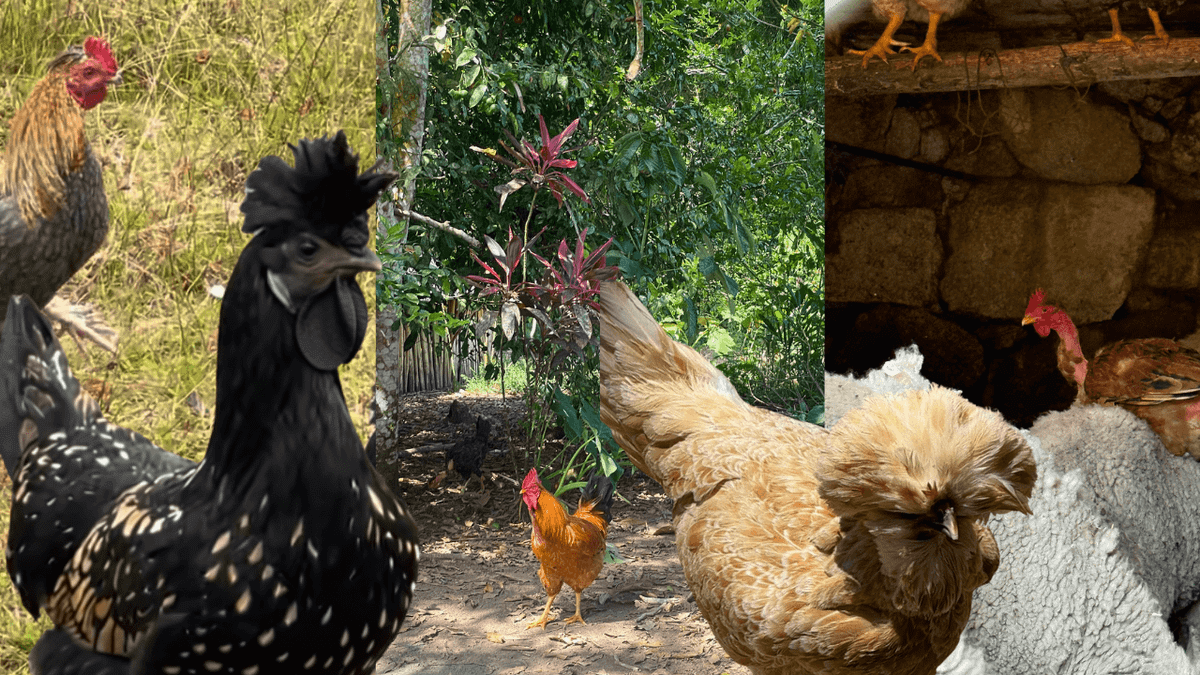
Think about how a chicken uses its claws to scratch around and uncover grit and bugs in the dirt and grass. You're going to do this with a draft piece of writing you already have.
- You need paper and a writing implement for this. Get that ready.
- Take an image, poem, line, or single idea you've already written. This can be something you pull from an existing draft. If you don't have anything to pull from, you can pull from some other poem or article or story you want to respond to, or just write something new.
- Now, close your eyes and ponder this idea for a moment. Prepare your claw as you ponder. Move your fingers around a bit for the drama.
- Keeping your eyes closed, start writing on the page around this idea, circling around the same image, expanding on it, breaking it apart, and so on. Do this for five whole minutes without opening your eyes. You are scratching! Ideally you're going to be writing really messy stuff. It's going to look terrible. Good!
- Open and read what you wrote. Circle an image or two that stand out to you or that you want to explore further.
- Go to a new part of the paper, or a new page, and repeat the same exercise. You could even try it with your non-dominant claw.
- Do this as many times as you feel like.
- Take a break from this for a few hours or days or weeks. We are all busy.
- The next time you sit down to work on this particular writing project, go back to this chicken scratch and try to make sense of it. If there are places where you can't understand your own writing, that's good! Draw a circle around those bits, and then write a "bad translation" of what you think it could mean.
The "bad translation" is another exercise I love. This one was introduced to me by one of my nature writing/poetry instructors and now friend, Byron F. Aspaas. He gave us a series of poems written in other languages and asked us to choose one where we did not have even a basic understanding of that language. We had to write a poem that was an intentionally bad translation possible of the poem. Mine was a translation of this Rilke poem, and ended up as this. Nothing will probably happen with the basket of bones poem I wrote, but it did give me some images I liked that I could, and probably will, pull out and use in other poems.
Friends, claw-havers: I hope that today, the light is warm in your basket of bones, too. If you think find any of this helpful, would you please consider forwarding this newsletter to someone else? Once I reach 100 subscribers, I'm going to make a five-dollar version of this available, which will have more offerings. But I need your help to get there!
Thanks and let me know how any of this goes.
-Ayla